

Why Billing Center exists
Running an organization on Cobo Portal produces two kinds of cost, and they work very differently. On-chain transaction fees. Every on-chain transaction incurs a fee, and the token used to pay it is usually not the token you are sending: sending USDC on Ethereum costs ETH; sending USDT on TRON consumes energy and burns TRX when energy runs short. Tokens used specifically to pay on-chain fees are called gas tokens. The moment a wallet address runs out of the chain’s gas token, the transaction fails. Handling this yourself means keeping a balance on every chain and every address, and watching all of them for depletion. Cobo’s monthly bill. Your plan subscription and any usage beyond it are billed monthly. Billing Center brings both together. You maintain a single balance in Billing Center (Credits), and Cobo deducts on-chain fees and monthly bills from it — no per-chain funding, no manual reconciliation.What fee sponsorship means
When a wallet address does not hold enough of a chain’s gas token to pay the fee, Billing Center pays it for that transaction. That is fee sponsorship. The transaction goes out as normal and the cost is deducted from your Billing Center balance. This means your operating wallet addresses do not need to hold any gas tokens to transact.Fee sponsorship covers transactions from MPC Wallets and Custodial Wallets (Web3 Wallets) on EVM-compatible chains, TRON, Solana, and Tempo. Other chains, such as BTC, are not supported — on those chains the wallet address must hold the fee itself.
The two balances
Billing Center holds two kinds of balance. What separates them is what each one can pay for:
Credits alone are enough to operate. Gas tokens are optional — enable them only if you want a chain’s fees charged to that chain’s own token instead of Credits.
For details, see Balances and how fees are charged.
Before you start
Log in to Cobo Portal and click Billing Center in the left navigation menu.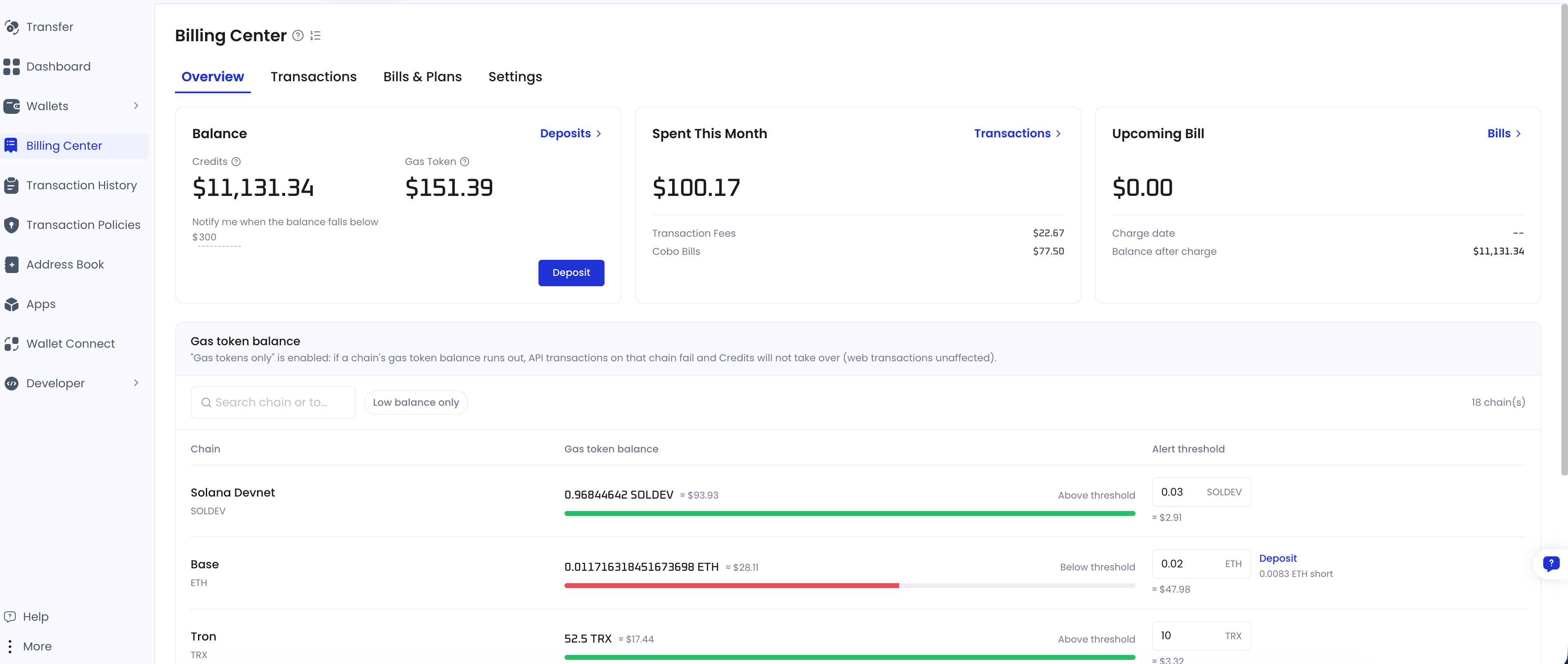
Billing Center was formerly called Fee Station. They are the same product, and some APIs still use the old name.
Next steps
- Initial setup — the two things to do for a new organization.
- Balances and how fees are charged — the deduction order, and how Portal and API transactions differ.